The Barred Owl is named (like a chicken) for the horizontal stripped or barred pattern on its feathers. We've heard them on our wooded property, but never seen one. One night, in the winter, Zach and I were sound asleep when we were both startled awake by the familiar "whoo-cooks-for-you, whoo-cooks-for-you-allllll" Which is what their "hoot" sounds like. The owl was so close it sounded as if it had landed on the roof under the window.
This photograph was taken at the Howell Nature Center. For their information visit the Fun Stuff and Good Reads page.
All of the photos that appear on Iron Oaks Farm blog were taken by Jennifer or Zach Sartell and are available for purchase. Please contact JenniferAnnMurphy@yahoo.com for prices or visit our Etsy site at http://www.jenniferannmurphy.etsy.com/ .
Wednesday, June 30, 2010
Tuesday, June 29, 2010
De-worming Goats
(The following is not in anyway an instructional on what you should do with your animals, only what we do. Please contact your livestock veterinarian for professional advise.)
On Knit and Purl's Birthday we also de-wormed them. (see June 28th, 2010 post Knit and Purl Birthday Injections) Zach and I purchase our de-wormer medication at Tractor Supply Company. Make sure you read all instructions before administering. There are several different dewormers you can use. There are pellets, injectable, and oral injectable. We de-worm our goats every two to four weeks depending on the type of de-wormer we last administered. A lot of people don't de-worm that regularly. But we've read that it's better to be proactive than re-active. And we only have the two goats for now so it's not that expensive ot teadious. If your not sure when to de-worm you can check their eye color. The skin around their eyes should be nice and pink, or if their activity level starts dropping it may be time to de worm. Also check their droppings. They should be solid little pellets. If this changes it may be time to de-worm. You can also bring a stool sample to your veterinarian and they can do a worm count.
We also rotate the different methods. We inject them every six months, then alternate between pellets and oral injections during the remainder of the year. We've read that the worms can build a tolerance to a de-wormer over time and it's best to alternate. We use ... for our pellet de wormer. Read the labels of the different kinds. Some de-wormers only cover 2 worms others cover 3 ... covers... The dosage is based on weight. I measure out their dosages and put them in small zip lock bags so it's easy to administer once the medicine is down in the barn where we store it.
To make sure each goat gets the right amount we de-worn them before we feed them their grain ration for the day. Then we lock one girl out and let the other in to eat her de-wormer out of her bowl. If we were to feed them at the same time, Purl would bully her sister and eat both. This method is the easiest, but also the most expensive, but again we only have 2 goats so it's not that big of a deal. It's around $12.00 a bag and we get 24 doses, so it's not really going to break the bank.
For the injectable de-wormer we do it only twice a year, every six month, partially because it's a little stronger because it goes directly into the blood stream, and partially because it's an awful experience. We use Ivomectrin which is really a dewormer for cattle but veterinarians recommend it for goats as well. The problem though, is that the medicine is thick like molasses, so it takes forever to inject. And it burns. So you have a wiggling goat who doesn't want to be held down, who doesn't want to have a needle in it's thigh and then the medicine hurts. The first time we did it, we thought they were dying. They were belting and bawling and falling all over trying to lick the injection spot. They made the most horrible noises, and all we could do was hold them and try to comfort them. Zach had read that they do this, but to actually see it is so sad. To see how we give the girls injections check out the June 4th, 2010 blog.
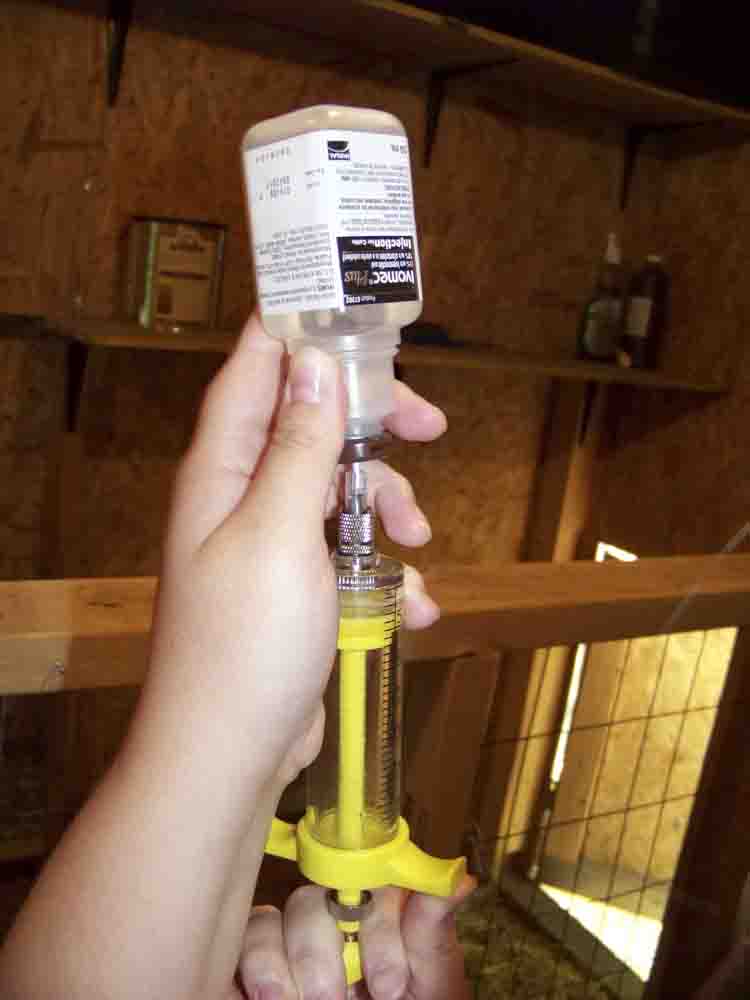
The third and maybe best de-worming method is oral injections. You can also administer Ivomectrin through an oral syringe, which is good because it's not that hard or painful for the goat and it's quite effective because it's Ivomectrin. We purchased a syringe at Tractor Supply we use the smaller one with the long metal tube that goes down their throat. Clean the syringe thoroughly with soap and water before and after use. You will still need an injection with a needle to get the medicine out of the Ivomectrin bottle because of the rubber seal, but you can just squirt it into the oral syringe. Take the needle and insert it into the rubber seal extract the correct dosage. Then unscrew the top of the oral syringe and squirt it into the tube. Your particular syringe may be different. Our metal tube wastes some of the medicine, so compare the two CC units. Then give it to the goats. Our goats are naturally curious about everything, and find it necessary to taste everything, coats, glasses, ponytails etc. So getting them to open their mouths around the syringe isn't really a problem, once their mouth is open I gentle shove it to one side of their tongue and down their throat. You don't have to go far, just enough so that they get most of it and it doesn't come out their mouth. They may cough a bit. After they seem to be ok, give them treats, so they know you love them and so they forget for next time.
On Knit and Purl's Birthday we also de-wormed them. (see June 28th, 2010 post Knit and Purl Birthday Injections) Zach and I purchase our de-wormer medication at Tractor Supply Company. Make sure you read all instructions before administering. There are several different dewormers you can use. There are pellets, injectable, and oral injectable. We de-worm our goats every two to four weeks depending on the type of de-wormer we last administered. A lot of people don't de-worm that regularly. But we've read that it's better to be proactive than re-active. And we only have the two goats for now so it's not that expensive ot teadious. If your not sure when to de-worm you can check their eye color. The skin around their eyes should be nice and pink, or if their activity level starts dropping it may be time to de worm. Also check their droppings. They should be solid little pellets. If this changes it may be time to de-worm. You can also bring a stool sample to your veterinarian and they can do a worm count.
We also rotate the different methods. We inject them every six months, then alternate between pellets and oral injections during the remainder of the year. We've read that the worms can build a tolerance to a de-wormer over time and it's best to alternate. We use ... for our pellet de wormer. Read the labels of the different kinds. Some de-wormers only cover 2 worms others cover 3 ... covers... The dosage is based on weight. I measure out their dosages and put them in small zip lock bags so it's easy to administer once the medicine is down in the barn where we store it.
To make sure each goat gets the right amount we de-worn them before we feed them their grain ration for the day. Then we lock one girl out and let the other in to eat her de-wormer out of her bowl. If we were to feed them at the same time, Purl would bully her sister and eat both. This method is the easiest, but also the most expensive, but again we only have 2 goats so it's not that big of a deal. It's around $12.00 a bag and we get 24 doses, so it's not really going to break the bank.
For the injectable de-wormer we do it only twice a year, every six month, partially because it's a little stronger because it goes directly into the blood stream, and partially because it's an awful experience. We use Ivomectrin which is really a dewormer for cattle but veterinarians recommend it for goats as well. The problem though, is that the medicine is thick like molasses, so it takes forever to inject. And it burns. So you have a wiggling goat who doesn't want to be held down, who doesn't want to have a needle in it's thigh and then the medicine hurts. The first time we did it, we thought they were dying. They were belting and bawling and falling all over trying to lick the injection spot. They made the most horrible noises, and all we could do was hold them and try to comfort them. Zach had read that they do this, but to actually see it is so sad. To see how we give the girls injections check out the June 4th, 2010 blog.
The third and maybe best de-worming method is oral injections. You can also administer Ivomectrin through an oral syringe, which is good because it's not that hard or painful for the goat and it's quite effective because it's Ivomectrin. We purchased a syringe at Tractor Supply we use the smaller one with the long metal tube that goes down their throat. Clean the syringe thoroughly with soap and water before and after use. You will still need an injection with a needle to get the medicine out of the Ivomectrin bottle because of the rubber seal, but you can just squirt it into the oral syringe. Take the needle and insert it into the rubber seal extract the correct dosage. Then unscrew the top of the oral syringe and squirt it into the tube. Your particular syringe may be different. Our metal tube wastes some of the medicine, so compare the two CC units. Then give it to the goats. Our goats are naturally curious about everything, and find it necessary to taste everything, coats, glasses, ponytails etc. So getting them to open their mouths around the syringe isn't really a problem, once their mouth is open I gentle shove it to one side of their tongue and down their throat. You don't have to go far, just enough so that they get most of it and it doesn't come out their mouth. They may cough a bit. After they seem to be ok, give them treats, so they know you love them and so they forget for next time.
Monday, June 28, 2010
Knit and Purl Birthday Injections, CDT Vaccine
(The following is not in anyway an instructional on what you should do with your animals, only what we do. Please contact your livestock veterinarian for professional advise.)
Knit and Purl turned 1 year on April 28th. Unfortunately for them, we didn't celebrate with cake and balloons. Instead, we spent the day trimming hooves and giving them injections and oral de-wormer. Every year you should vaccinate a goat with it's CDT shot which prevents Tetanus and Entertoxema (Overeating Disease). You can find syringes and vaccines at Tractor Supply. We use Durvet from Tractor Supply Company (Durvet Link). Read labels and instructions carefully, some medications must be refrigerated, With Durvet, the left over medicine should be disposed of. Most injection amounts (CC Units) are based on the weight of the animal. Our girls weigh approximately 80 lbs each, so we give them 2 ml or (2 CC units).
We use a clean needle for each animal and dispose of the needles in proper containers.
My dad was diabetic so we use his "hazardous waste" containers. Then contact your health department for legal disposal in your area, do not throw used needles in the garbage! This is extremely dangerous, think of your garbage men and if they were poked with a strange needle how they would have to undergo medical testing to rule out infectious diseases.
We use a clean needle for each animal and dispose of the needles in proper containers.
My dad was diabetic so we use his "hazardous waste" containers. Then contact your health department for legal disposal in your area, do not throw used needles in the garbage! This is extremely dangerous, think of your garbage men and if they were poked with a strange needle how they would have to undergo medical testing to rule out infectious diseases.
I was very proud and nervous to give my first injection. Zach has injected the girls with de-wormer, but this was my first CDT shot. They're getting larger and stronger and it was better for him to do the holding and me to do the injecting this time.
Our first goal was to stay as clean as possible. We took the goats out away from the stalls and into the clean or rather (straw free) area of the barn.
We prepared all the injections before hand and replaced the protective caps on the needles and lay them on a clean paper towel so their easy to access.
To prepare the injections take the needle and pull the suction back so it lines up with the right CC line on the tube. Insert the needle into the vaccine bottle through the rubber seal. Inject the air into the bottle, (this stops the vacuum effect) then suction out more than the correct amount of medicine. I flick the syringe to get the air bubbles to the top then re-inject the extra medicine back into the bottle until the suction lines up with the correct CC unit line.
We prepared all the injections before hand and replaced the protective caps on the needles and lay them on a clean paper towel so their easy to access.
To prepare the injections take the needle and pull the suction back so it lines up with the right CC line on the tube. Insert the needle into the vaccine bottle through the rubber seal. Inject the air into the bottle, (this stops the vacuum effect) then suction out more than the correct amount of medicine. I flick the syringe to get the air bubbles to the top then re-inject the extra medicine back into the bottle until the suction lines up with the correct CC unit line.
Zach holds the girls on their side. He grabs the front "ankles" with one hand and the back "ankles" with the other hand. Then he sweeps them on their side and kneels on their neck. Their neck fits into the crevasse between his knee and his foot against the floor, so he's actually not putting any pressure on their neck just keeping their head wedged. Then while their being held, I separate the fibers on their thigh to find skin beneath all those curls and swab the area really well with alcohol and a cotton pad. Then I remove the needle cap, pinch the skin up so you have a little triangle of skin at each end of your pinched fingers, inject the needle into the triangle just under the skin. These injections should not go into the muscle. If the goats start to wiggle, let go. It's better for the needle to go flying, then to tear the goats skin or inject yourself. They may lick the area for a while, but they'll be fine in a few minutes. We always give them goat treats after injections to get back on their good side and to reward them for being so brave.
(check out the January 26th, 2010 blog to see how we trim the girls' hooves. It's titled Trimming Goats Hooves, the Girl's get a Manicure)
Friday, June 25, 2010
Fiery Friday - Let The Anvil Ring
Welcome back everyone,
Today I'm going to show you another tool of the Blacksmith. This is the tool that everyone associates with the blacksmith, the anvil. When most people think of an anvil they picture the typical "English Pattern" anvil, which is what I have to show you today. But just because it doesn't look like an anvil, doesn't mean it can't be. Anvils aren't exactly cheap and if you open your mind you can find a suitable anvil just about anywhere. My first anvil I used was an old engine block. Granted it had it's limitations, but it worked well enough.
Here is my larger anvil. It is a Wilkinson that weights 252 pounds. Most anvils from England were measured in hundred weight. That means you will find three numbers on it, the first you multiply by 112, the second by 28 and the third is the actual number. This means that my anvil has the numbers 210 on it. That is 2 X 112 plus 1 X 28 plus 0. There are many different parts to an anvil. On the right is a rounded tapered section that is called the horn. Completely oposite that on the left is the heel. The top flat section is the face and on the face over the heel side is the hardy hole and a pritchel hole. This anvil actually has two pritchel holes.
But what is all of this stuff for? We'll start with the heel end. The heel itself is just a place to put the hardy and pritchel holes. These holes go all the way through The square hole is the hardy hole and it is used to hold tooling such as the bending forks I have in the picture. It can also be used to run drifts through a piece of steel. It got it's name because the tools that are put in it are used of "hard" steel rather than soft wrought iron. They need to be hard just like the anvil face as they take a lot of abuse. The round hole is the pritchel hole and is used to allow a relief under a piece of steel when using a punch and can also also be used for running a drift through a piece of steel. Here you can also see some of my silver pencil markings for some quick measuring without needing to find a scale while holding a red hot piece of steel.
Now the top of the anvil is called the face and it's used for general forging, flattening out pieces and is great for straightening out long pieces. In the picture you can see the horn. The horn works great for bending steel and since it's tapered it has many different diameters to work with. It can also be used as a bottom fuller (a fuller is a rounded tool for stretching steel) and the tip is great for opening up pipe when making candle cups. Notice a flat section on the largest part of the horn. This is called the table and it is used when chiseling through steel. It is sort of sacrificial and keeps you from putting a mark in the anvil face.
I know I didn't go into extreme detail on all of the uses of each part of the anvil (honestly I didn't want to bore you too much), but as least now you have the basics. Just about every edge on the anvil can be used to forge in one way or another. So next time you think of an anvil you'll realize they're not just used for dropping on road runners.
Thanks for stopping in,
Zach Sartell
http://ironoakfarm.blogspot.com/
Today I'm going to show you another tool of the Blacksmith. This is the tool that everyone associates with the blacksmith, the anvil. When most people think of an anvil they picture the typical "English Pattern" anvil, which is what I have to show you today. But just because it doesn't look like an anvil, doesn't mean it can't be. Anvils aren't exactly cheap and if you open your mind you can find a suitable anvil just about anywhere. My first anvil I used was an old engine block. Granted it had it's limitations, but it worked well enough.
Here is my larger anvil. It is a Wilkinson that weights 252 pounds. Most anvils from England were measured in hundred weight. That means you will find three numbers on it, the first you multiply by 112, the second by 28 and the third is the actual number. This means that my anvil has the numbers 210 on it. That is 2 X 112 plus 1 X 28 plus 0. There are many different parts to an anvil. On the right is a rounded tapered section that is called the horn. Completely oposite that on the left is the heel. The top flat section is the face and on the face over the heel side is the hardy hole and a pritchel hole. This anvil actually has two pritchel holes.
But what is all of this stuff for? We'll start with the heel end. The heel itself is just a place to put the hardy and pritchel holes. These holes go all the way through The square hole is the hardy hole and it is used to hold tooling such as the bending forks I have in the picture. It can also be used to run drifts through a piece of steel. It got it's name because the tools that are put in it are used of "hard" steel rather than soft wrought iron. They need to be hard just like the anvil face as they take a lot of abuse. The round hole is the pritchel hole and is used to allow a relief under a piece of steel when using a punch and can also also be used for running a drift through a piece of steel. Here you can also see some of my silver pencil markings for some quick measuring without needing to find a scale while holding a red hot piece of steel.
Now the top of the anvil is called the face and it's used for general forging, flattening out pieces and is great for straightening out long pieces. In the picture you can see the horn. The horn works great for bending steel and since it's tapered it has many different diameters to work with. It can also be used as a bottom fuller (a fuller is a rounded tool for stretching steel) and the tip is great for opening up pipe when making candle cups. Notice a flat section on the largest part of the horn. This is called the table and it is used when chiseling through steel. It is sort of sacrificial and keeps you from putting a mark in the anvil face.
I know I didn't go into extreme detail on all of the uses of each part of the anvil (honestly I didn't want to bore you too much), but as least now you have the basics. Just about every edge on the anvil can be used to forge in one way or another. So next time you think of an anvil you'll realize they're not just used for dropping on road runners.
Thanks for stopping in,
Zach Sartell
http://ironoakfarm.blogspot.com/
Thursday, June 24, 2010
Tomato Basil Flatbread
Here is a delicious recipe to try with your homemade Mozzarella (see 6-10-10 post Making Mozzarella). It makes a great lunch, or light dinner.
You will need:
store bought flat bread
extra virgin olive oil
dried Italian seasonings (basil and oregano taste great)
garlic powder
shredded Mozzarella
fresh basil chopped
sliced Roma tomatoes
sea salt
Brush the flat bread with a light coating of olive oil. Sprinkle with Italian seasonings and garlic powder. Top with Mozzarella, tomato slices, chopped fresh basil and a dash of salt. Toast in the toaster oven until cheese melts and is bubbly. Slice and serve.
You will need:
store bought flat bread
extra virgin olive oil
dried Italian seasonings (basil and oregano taste great)
garlic powder
shredded Mozzarella
fresh basil chopped
sliced Roma tomatoes
sea salt
Brush the flat bread with a light coating of olive oil. Sprinkle with Italian seasonings and garlic powder. Top with Mozzarella, tomato slices, chopped fresh basil and a dash of salt. Toast in the toaster oven until cheese melts and is bubbly. Slice and serve.
Wednesday, June 23, 2010
Wild Wednesday, Cecropia Moth or Garden Giant
About five years ago, Zach and I were hiking through the wooded hills behind our home. Our property butts up against the Edison easement and the wood's open up to a grassy plain area where the power lines run through like giant skeletons linked for miles and miles.
In these grassy areas, there are always things that catch the eye, especially in the fall and winter when the green has drained it's color from the lush hills and often nature has a way of drying itself and preserving into the most interesting things that can be collected.
I'm always on the lookout for strange seed pods that have turned brown and crisp with the coming of colder weather, acorns, pine cones, maple seed "helicopters," black walnuts, they are like little treasures that allow us to hold nature in our hands.
While Zach and I were hiking, I came upon one of these little mysteries. It was a mossy little pod, attached to a stick. I broke off the stick and carried the pod home to be filed in with the many mason jars, and mossy Terra cotta pots that hold past wonders that I've collected on similar walks.
Truth be told, by next spring I had forgotten about the pod, until one day as the weather warmed a giant beautiful moth emerged from the ugly brown casing. It was the largest moth I had ever seen, as big as my hand.
After some research we found that it was the Cecropia Moth, or Garden Giant and is the largest moth in North America. I framed the photo above and hung the opened cocoon next to it.
In these grassy areas, there are always things that catch the eye, especially in the fall and winter when the green has drained it's color from the lush hills and often nature has a way of drying itself and preserving into the most interesting things that can be collected.
I'm always on the lookout for strange seed pods that have turned brown and crisp with the coming of colder weather, acorns, pine cones, maple seed "helicopters," black walnuts, they are like little treasures that allow us to hold nature in our hands.
While Zach and I were hiking, I came upon one of these little mysteries. It was a mossy little pod, attached to a stick. I broke off the stick and carried the pod home to be filed in with the many mason jars, and mossy Terra cotta pots that hold past wonders that I've collected on similar walks.
Truth be told, by next spring I had forgotten about the pod, until one day as the weather warmed a giant beautiful moth emerged from the ugly brown casing. It was the largest moth I had ever seen, as big as my hand.
After some research we found that it was the Cecropia Moth, or Garden Giant and is the largest moth in North America. I framed the photo above and hung the opened cocoon next to it.
Tuesday, June 22, 2010
New Products!!
I just listed some new products from Iron Oaks Farm on our Etsy site http://www.jenniferannmurphy.etsy.com/ They include a darling, hyper feminine apron. The skirt has different herb descriptions and their uses in a pretty brown script. It also has handy pockets that work well in the garden or kitchen.
Monday, June 21, 2010
Glossy Strawberry Jam
After berry picking, one of the best ways to preserve all those delicious berries is to can them into jams and jellies. You'll thank yourself come winter.Your will need:
- canning jars with new lids
- berries
- sugar
- pectin (there are many types of pectin, use the recipe for your type of pectin)
- pairing knife
- colander and bowl for soaking and rinsing the berries
- giant pot for sterilizing and processing
- optional canning supplies, funnel for ladling the jam into jars, a jar grabber, magnet on a stick to pick up the lids from the bottom of the boil pot. (There are many gadgets that can help with the canning process, many times you can substitute these items for things you already have in your kitchen, but they can make the process easier, and are relatively inexpensive.)
Start by removing all the green leaves from each of the strawberries. You can purchase a fancy do-hicky that is designed just for that task, but a pairing knife works just fine. We compost all the scraps.
Then wash the berries several times in cold running water with a bowl in a colander. I rinse until the water in the bowl is clear.
In the meantime start your water boiling to sanitize the jars. We run them through the dishwasher then boil them and the lids for 10 minutes. Place on a clean towel to dry. Read instructions carefully, there are lots of factors that effect boiling times for jam, including elevation levels.
Each pectin recipe is slightly different depending on the brand you buy. Some call for lemon juice, some alternate the order in which you boil the strawberries, sugar and pectin. We used Sure-Jell this time. It called for 5 cups of crushed strawberries and 7 cups of sugar. We use a hand pastry blender to mash our berries. A food processor blends them a little too much for my taste. I like my jam chunky.
Then we heated the berries and the sugar until they boiled. Once they boiled for the correct amount of time, we added the pectin and let them boil for one remaining minute. We skim off the foam with a shallow spoon. Some recipes you can add margarine or butter to reduce foam, but this is optional. After that we ladle the hot jam into the jars using our funnel. Wipe each jar with a damp paper towel to remove residue so the lid seals properly. Then place the jars back into the boiling pot bring back to a boil and boil for 12 minutes. Remove carefully. And let cool, if you did it right, the jar lids will pop. pop, pop and seal...ahhh music to my ears.
Check out the Hobby Farm Home July/August 2010 magazine. They have some interesting recipes for infusing your jams and jellies with fresh herbs.
Friday, June 18, 2010
Fiery Friday, Saddle Hooks
Welcome back everyone,
Today I thought I’d show you a project I was working on last week. I was commissioned to make some hooks for a gentleman we’ve bought some of our chicks from. In the end I ended up trading the hooks for some Lavender Orphington chicks. Now these hooks are designed to stick right into a wooden beam in a barn. To do that, the hook has a nail built right into it.
I started with a 1/4" round piece that was 17" long. The first step is to make the nail end by tapering the end square so it has a nice point about 3" long.
Step two takes me over to my leg vise to bend 3-1/2" of the taper back onto itself. I just clamped it into the vice and taped it with my hammer until it was at a 90 degree bend.
To finish bending I pulled the piece out of the vice and quickly went to the anvil to tap it the rest of the way.
Now it's back to the vice to pull all of it apart except for about a 1/2". This will create a nub for a hammer to strike the nail in.
The fishtail scroll is the steel flattened out into a fishtail shape and then scrolled to create a softer tip of the hook.
Once it is nice and flat I bend the tip over the edge of the anvil and then flip it over and tap it back upon itself until I get a nice little scroll.
After I heat it up again I quickly quench the scroll I just formed to keep it from deforming if I need to tap it with the hammer while bending the hook itself. For these I used the larges part of the horn to create the hook. I started by hanging the tip of the steel over the horn and taping it with my hammer. Each tap I pushed the steel further over the horn, but kept taping over the same place on the horn. This gave me a nice uniform hook.
Then all I need to do is straighten it up a bit with the remaining heat and it's done. I made six of these and modeled them after one that he had salvaged from his old burned down barn. Thanks for stopping by.
Today I thought I’d show you a project I was working on last week. I was commissioned to make some hooks for a gentleman we’ve bought some of our chicks from. In the end I ended up trading the hooks for some Lavender Orphington chicks. Now these hooks are designed to stick right into a wooden beam in a barn. To do that, the hook has a nail built right into it.
I started with a 1/4" round piece that was 17" long. The first step is to make the nail end by tapering the end square so it has a nice point about 3" long.
Step two takes me over to my leg vise to bend 3-1/2" of the taper back onto itself. I just clamped it into the vice and taped it with my hammer until it was at a 90 degree bend.
To finish bending I pulled the piece out of the vice and quickly went to the anvil to tap it the rest of the way.
Now it's back to the vice to pull all of it apart except for about a 1/2". This will create a nub for a hammer to strike the nail in.
The fishtail scroll is the steel flattened out into a fishtail shape and then scrolled to create a softer tip of the hook.
Once it is nice and flat I bend the tip over the edge of the anvil and then flip it over and tap it back upon itself until I get a nice little scroll.
After I heat it up again I quickly quench the scroll I just formed to keep it from deforming if I need to tap it with the hammer while bending the hook itself. For these I used the larges part of the horn to create the hook. I started by hanging the tip of the steel over the horn and taping it with my hammer. Each tap I pushed the steel further over the horn, but kept taping over the same place on the horn. This gave me a nice uniform hook.
Then all I need to do is straighten it up a bit with the remaining heat and it's done. I made six of these and modeled them after one that he had salvaged from his old burned down barn. Thanks for stopping by.Thursday, June 17, 2010
Ironing- A Memoir
This is not a post about how to "negotiate pleats" quoted from the brilliant John Travolta in his trans-sexual part as the laundress and mother of the large haired Tracy Turnblatt. (See the musical Hairspray, one of my favorites!) No, this post is about a thought I had while standing in our family room. I was ironing one of Zach's shirts for him for work the next day. I drug out the old metal ironing board with the same green plaid ironing pad, that has starch forever baked into the fibers. I heard that same familiar creaking noise as I pulled the leg open and situated the large awkward thing in the middle of the room so the iron cord would reach. For a short moment, I was the silhouette of my mother and how she spent many a days smoothing the wrinkles from our families clothes. How this was a small, unnoticed act of love. And only now that I am starting my own family do I see why she did it.
I remember as a child playing in our orange carpeted family room, as my mother ironed piles of my father's dress shirts. My father wore a neck tie to work everyday, and polished wing tip shoes. I can still hear the fitzzzz of the Niagara Spray Starch as she whizzed it across a sleeve or a collar. I remember the smell of the heated steam as it puffed faint remnants of starch and fabric softener, and mingled with the waxy/plastic smell of Lego's and crayons.
I remember thinking, what a silly thing ironing was. As a child, the ironed clothes didn't look much different from the un-ironed ones, and my mother spent hours at this chore. I would ask her to play, because this whole task seemed like a big waste of time, but kindly she would say no, and tell me stories of the days before permanent press, and spray wrinkle releases and how my grandmother used to iron anything and everything, including sheets and underwear. I guess she saw this as a suitable explanation, fraught with appreciation of modern advancements, and most of the time, whether I understood or not, I would drop the subject without further question.
I remember my fathers dress shirts being hung around the chairs of the kitchen table and how I was to treat them as precious porcelain. I would run upstairs for my mother and grab a wad of tangled hangers for her to hang them. She would, and then she would carry the pile upstairs to my dad's side of their closet and hang them like a row of thin soldiers, neat and straight and somewhat reminiscent of my father.
As an adult, I now see the significance of "i-roning" as I used to say when I was little. To me it says, I love you, I do this so you don't have to, and maybe Zach will smile just a little bit in the morning, because there's nothing quite like buttoning up a crisply ironed shirt.
I remember as a child playing in our orange carpeted family room, as my mother ironed piles of my father's dress shirts. My father wore a neck tie to work everyday, and polished wing tip shoes. I can still hear the fitzzzz of the Niagara Spray Starch as she whizzed it across a sleeve or a collar. I remember the smell of the heated steam as it puffed faint remnants of starch and fabric softener, and mingled with the waxy/plastic smell of Lego's and crayons.
I remember thinking, what a silly thing ironing was. As a child, the ironed clothes didn't look much different from the un-ironed ones, and my mother spent hours at this chore. I would ask her to play, because this whole task seemed like a big waste of time, but kindly she would say no, and tell me stories of the days before permanent press, and spray wrinkle releases and how my grandmother used to iron anything and everything, including sheets and underwear. I guess she saw this as a suitable explanation, fraught with appreciation of modern advancements, and most of the time, whether I understood or not, I would drop the subject without further question.
I remember my fathers dress shirts being hung around the chairs of the kitchen table and how I was to treat them as precious porcelain. I would run upstairs for my mother and grab a wad of tangled hangers for her to hang them. She would, and then she would carry the pile upstairs to my dad's side of their closet and hang them like a row of thin soldiers, neat and straight and somewhat reminiscent of my father.
As an adult, I now see the significance of "i-roning" as I used to say when I was little. To me it says, I love you, I do this so you don't have to, and maybe Zach will smile just a little bit in the morning, because there's nothing quite like buttoning up a crisply ironed shirt.
Wednesday, June 16, 2010
Wild Wednesday, Great Horned Owl
The Great Horned Owl is an amazing, mysterious bird. On clear nights we can sometimes hear them in the woods calling that erie "Whoo-hoo-hoo" The best time of year, that I've found to view owls and hawks, or any bird of prey for that matter is in late January and February. Not only are the trees barren and the woods are bare, but this is the birds of prey mating season, and they seem to be more active.
Most times when I've had the pleasure of seeing a nocturnal bird of prey has been in the dead of winter, with the exception of the last photograph in this post. This was taken in June of 2005. It was either a juvenile bird or it was injured. It stayed near the pond for three days, and wouldn't fly when we approached it to take pictures. The two photos at the top were taken at the Birds of Prey Photography Workshop at the Howell Nature Center. (View the "Fun Stuff and Good Reads" page for their information and website) It is a wonderful program for anyone interested in nature or photography.
I also recommend attending the Owl Nights workshop at the HNC. It is an evening event where the first half of the workshop you get to see real owls up close in a classroom setting. The handlers bring the owls right up to the audience. They teach you fascinating facts about owls and their behaviors. We saw owl pellets too, which are the regurgitated remains of the bones, feathers and anything else non-digestible to the owl. We had a hawks nest once in our yard, and everyday I would search the ground below for pellets... didn't find any. We also learned that one of the tragic causes for owl deaths is second hand poisoning. When people poison mice, the owls sometimes eat the mice before they die, and are in turn, poisoned themselves. All of the captive birds at the Howell Nature Center have been injured in some way, so that they are unable to be released into the wild. They are essentially a rehabilitation center and try to care for and release as many animals as they can. The ones that stay behind are used for educational purposes, and help bring awareness to people in hope of preventing more animals from being harmed. All of the photos posted on Iron Oaks Farm blog are taken by Jennifer or Zach Sartell (unless otherwise noted) and some are available for purchase. Please e-mail me at JenniferAnnMurphy@yahoo.com for print prices.
Tuesday, June 15, 2010
The Sweet Smell of Summer Strawberries
There is nothing better than driving through a field, on a warm summer day and smelling acres of sweet ripening strawberries wafting through the open windows.
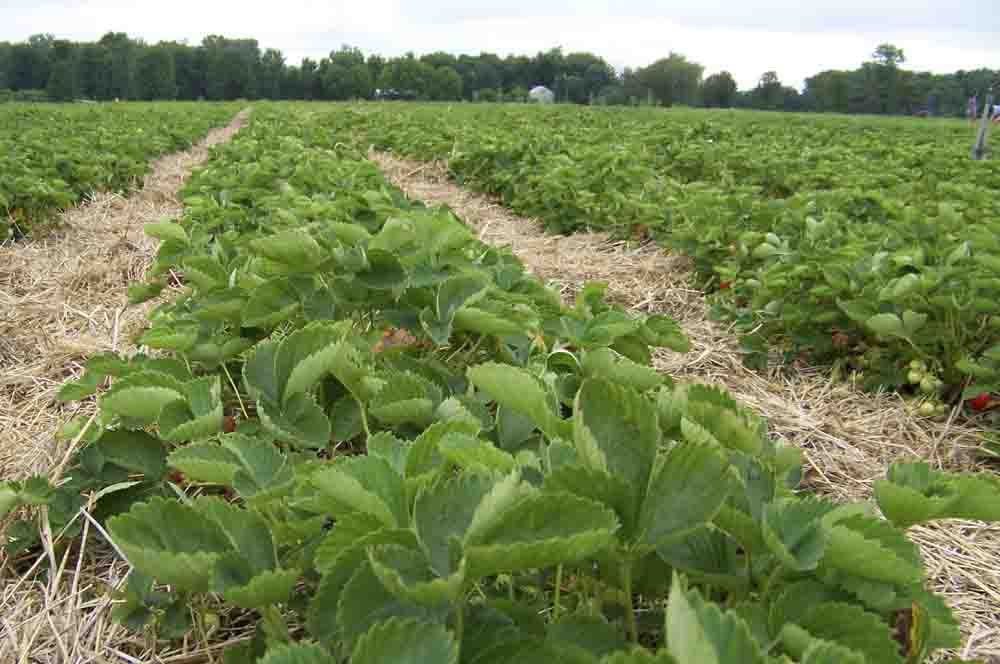
We went to Blakes last week for their opening day of strawberry season.
The strawberries were so abundant this year, that it only took about 20 minutes to pick all these berries.
Someone once told me that you pick strawberries at the 4th of July, and I've lived by that rule. But every year around the 4th, it seems like the berries are all picked over. This year I visited Blakes website in early June instead of July to see when strawberry season actually starts. It started on the 8th of this week and the berries were beautiful!
Visit Blakes website on the "Fun Stuff and Good Reads Page" to see what's in season. Sweet cherry season is coming up next. We checked out the Cherry trees as we were leaving and the berries have about another week before they're ripe.
We went to Blakes last week for their opening day of strawberry season.
The strawberries were so abundant this year, that it only took about 20 minutes to pick all these berries.
Someone once told me that you pick strawberries at the 4th of July, and I've lived by that rule. But every year around the 4th, it seems like the berries are all picked over. This year I visited Blakes website in early June instead of July to see when strawberry season actually starts. It started on the 8th of this week and the berries were beautiful!
Visit Blakes website on the "Fun Stuff and Good Reads Page" to see what's in season. Sweet cherry season is coming up next. We checked out the Cherry trees as we were leaving and the berries have about another week before they're ripe.
Monday, June 14, 2010
Beets, Beats & Eats 2010
Iron Oak Farm has been invited to sponser an upcoming event. The Ortonville DDA presents Beats, Beets, &; Eats. "The Unconventional Farmers Market" The events range every Friday night 6pm - 9pm starting June 18th - September 3rd at Crossman Park, Downtown Ortonville, Mi
downtownortonville.org
The nights include free kids acitivities, arts and craft, live music, 50/50 raffles, local produce, and dinner from local vendors.
Each night has a different theme and we are sponsering "Sustainable Living Night" July 23rd. Come check it out!!
June 18 Art Contest/ MacPhee's
June 25 Kids Night/ Papa Bella's
July 2 Community Outreach/ OUMC
July 9 Desert Angel Packing/ OUMC
July 16 Bike Night/ DDA
July 23 Sustainable Living/ OUMC (Iron Oak Forge)
July 30 Classic Car/ Kids Night/ OUMC
August 6 Quilt Show
August 13 Pet Night
August 20 Kids Night/ Papa Bella's
August 27 Garden Exchange/ OUMC
Sept 3 Photo Contest/ OUMC
downtownortonville.org
The nights include free kids acitivities, arts and craft, live music, 50/50 raffles, local produce, and dinner from local vendors.
Each night has a different theme and we are sponsering "Sustainable Living Night" July 23rd. Come check it out!!
June 18 Art Contest/ MacPhee's
June 25 Kids Night/ Papa Bella's
July 2 Community Outreach/ OUMC
July 9 Desert Angel Packing/ OUMC
July 16 Bike Night/ DDA
July 23 Sustainable Living/ OUMC (Iron Oak Forge)
July 30 Classic Car/ Kids Night/ OUMC
August 6 Quilt Show
August 13 Pet Night
August 20 Kids Night/ Papa Bella's
August 27 Garden Exchange/ OUMC
Sept 3 Photo Contest/ OUMC
Friday, June 11, 2010
Fiery Friday, The Twisting Wrench
Hello Everyone,
First off I'd like to thank everyone that stopped in and visited us at CreekFest in Ortonville last Saturday. Jennifer and I had a lot of fun and got to meet a lot of nice people. The only downside was the sun. I forged in the sun next to my propane forge and I think I went through 7 Gatorades to keep hydrated. But, we did have a few sales and I got a few custom orders, so all in all it was a good day.
I wanted to show you some of my tools once in a while so you can get a better idea of how I forge. This is a twisting wrench used to, yep you guessed it, twist steel. The hard part about being a blacksmith is that you can't just go to the local tool store to find blacksmithing tools. The great thing about being a Blacksmith is that you can make your own tools and make them the way you want to. Actually, I have to admit that sometimes I enjoy making new tools more than using them. Anyway, the key to a good twisting wrench it that it is adjustable and has a handle on both sides. Since it's adjustable I can use it with just about any size stock that I use. Here I took an old adjustable wrench and welded a piece of steel on the end of it so I have a good handle on both sides. This allows me to keep the steel straight while it is being twisted. You have to keep in mind that when the steel is yellow hot, it is very malleable and not only easy to twist, it will also bend back and forth very easily. If you are looking to make your own twisting wrench a great place to look is the flea markets. I picked mine up for $4 at our local flea market. Now I have tons of ideas for Fiery Fridays here at Iron Oaks Farm, but I would really be interested in hearing from you as to what you want me to show you. Let me know what you want and I'll see what I can come up with.
Thanks for stopping in,
Zach
Thursday, June 10, 2010
Making Mozarella
Zach and I LOVE cheese! Last year we bought a book called "Home Cheese Making", by Ricki Carroll. The book is filled with 75 different cheese recipes. Pluse literature on technique, methods and rescources.
We made the 30 minute mozzarella. While I can't share the recipe due to copyright laws, I can share some pictures and hints as to how we did with the process.
The cheese recipe worked like a charm. The picture shown to the left is the curds seperating from the whey after we added the rennet.
We bought our Rennet, citric acid and cheese cloth from a local brewery supply store called Hopmans on Walton and Dixie Hwy in Waterford. They carry a few cheese making supplies including complete kits. The owner is one of the nicest guys you'll ever meet and is going to start carrying Zach's hand forged bottle openers.
We ended up adding almost 21/2 times more salt than the recipe called for. And we all but burned our hands while kneading the final hot cheese, but the cheese was delicious after it cooled.
Wednesday, June 9, 2010
Wild Wednesday, Blue Heron Nests
Last year (March 16th to be exact) I was on my way to our gym when I saw these large black masses in a tree a ways away. I thought maybe a group of turkey vultures had landed and were waiting to swoop down on something dead, but I was too far away to be sure. So I detoured from the gym (it isn't hard to do...ahem...) and followed the backroads catching a glance through the trees now and again to make sure they were still there. As I drove and drove it became more and more strange that the "Turkey Vultures" weren't moving. When I finally came upon what I had seen it was a breath taking site.
The road opened to a swamp where long since drowned trees stood naked and bare. In the trees were clutches of giant nests.
Intrigued... I skipped the gym (...ahem) and went straight home to look up what these nests belong to. I had seen Eagles nests up north but they were bult of large sticks/small logs and were more flat and solitary, and Eagles aren't exactly common this far south. I'd seen hawks nests as well, and they were always solitary also. The weird thing about these nests, were that there were so many of them together.
Turkey Vultures were my next guess because they always seem to be flying in groups, so maybe they nested in groups, but afer some research I found that Vultures nest in caves, burrowed trees that have fallen or, if you read the May 12th, 2010 post, in the attic of old barns. I also considered Sandhill cranes because it was a swampy area, but they also nest on the ground. Finally I found that this was a clutch of Great Blue Heron nests. I went back the next day and in coincidence, the Great Blue Herons had arrived from their migration trip. It was amazing! I lost count at 22 birds, swooping and casting magnificent shadows across the ground. I read on the internet that the nests are around 3 feet wide and that both parents help in raising young.
The photos of the Great Blue Heron standing in the pond with Lilly Pads and the one Flying were taken on a kayaking trip with my faminly on the Huron River. All pictures that appear on Iron Oak Farm's blog are taken by Jennifer or Zach Sartell (unless otherwise noted) and are for sale.
Visit our site http://www.jenniferannmurphy.etsy.com/
If you don't see it there, inquire at JenniferAnnMurphy@yahoo.com
Visit our site http://www.jenniferannmurphy.etsy.com/
If you don't see it there, inquire at JenniferAnnMurphy@yahoo.com
Prints start 8x10 for $15
Subscribe to:
Posts (Atom)